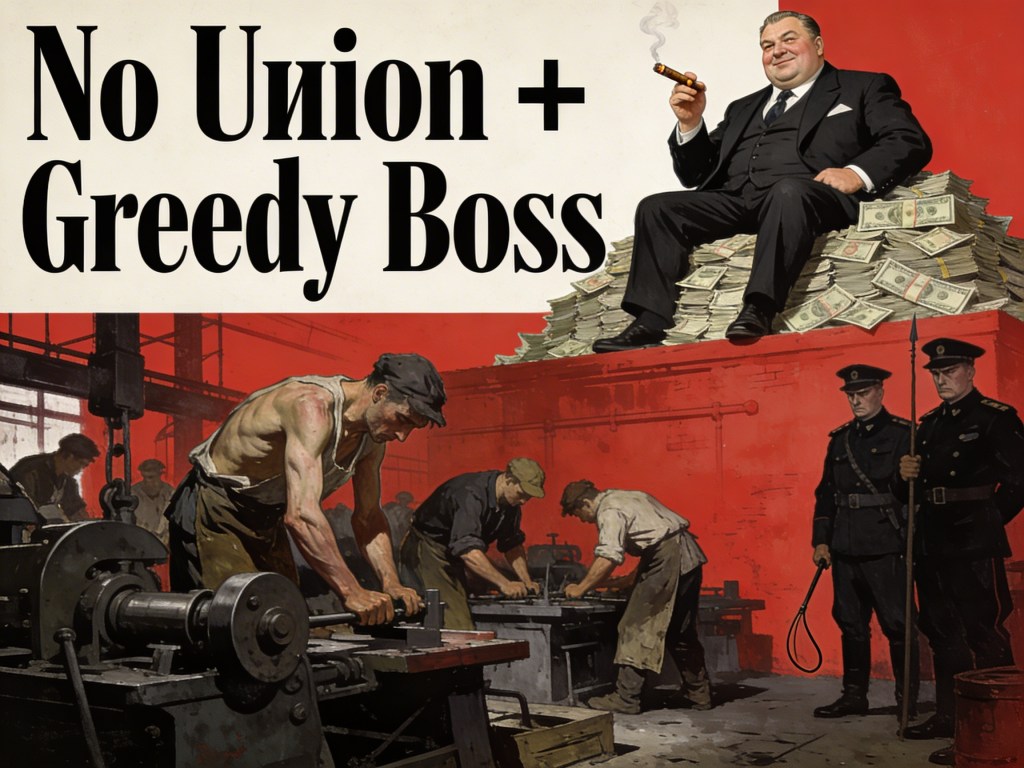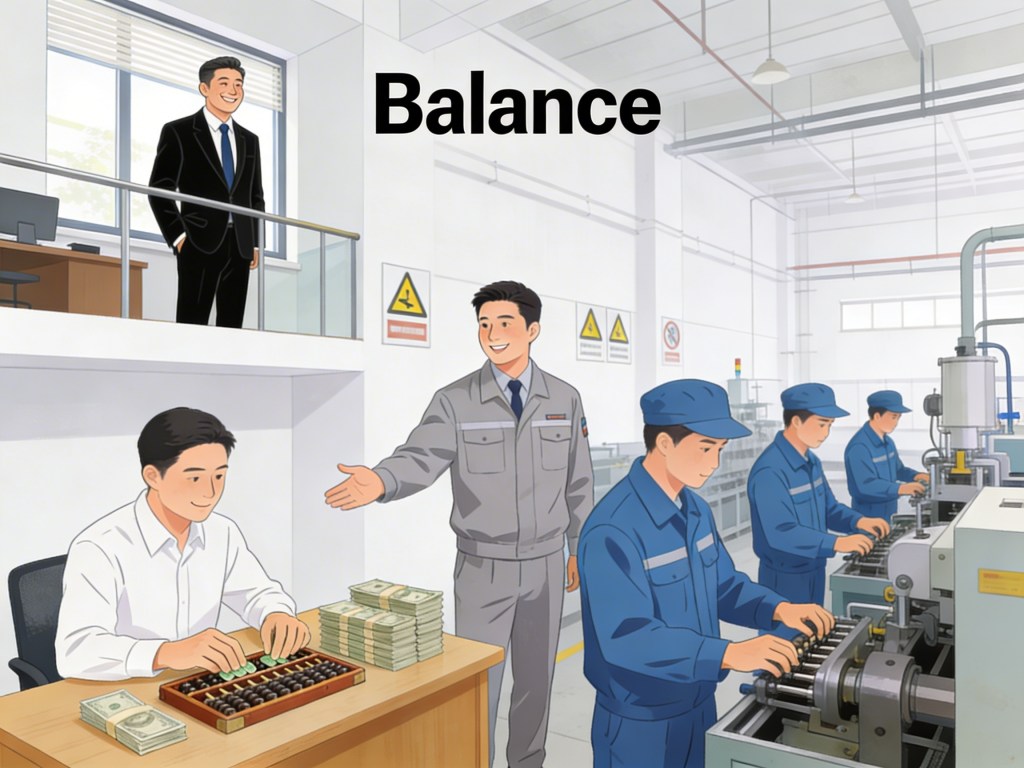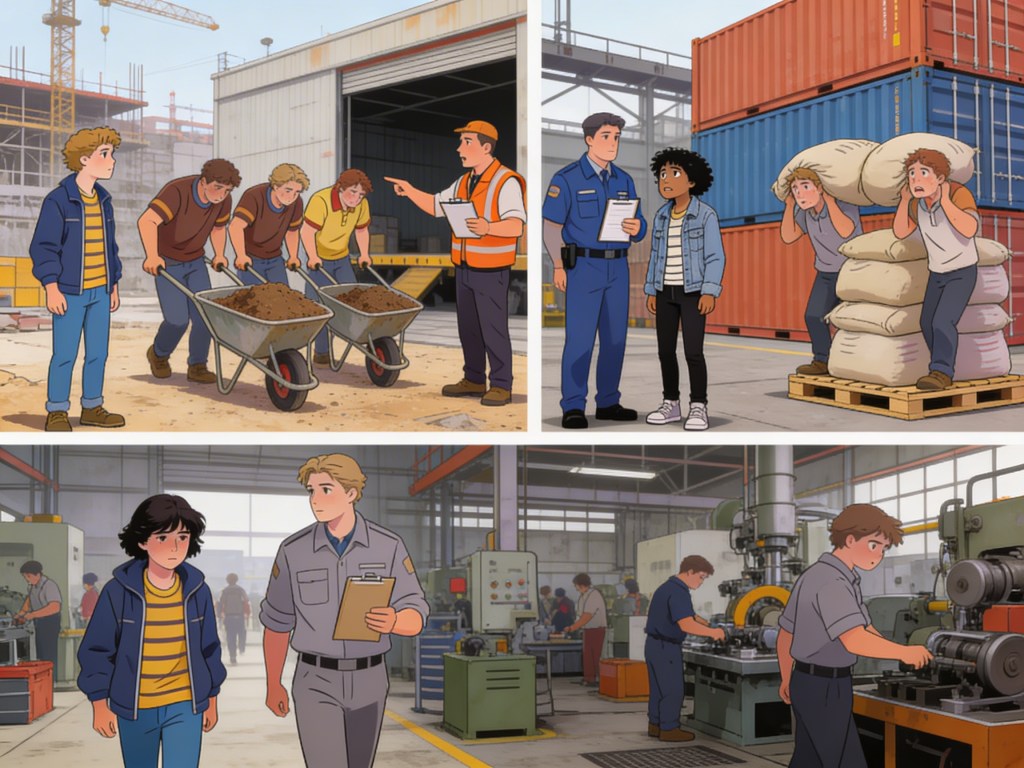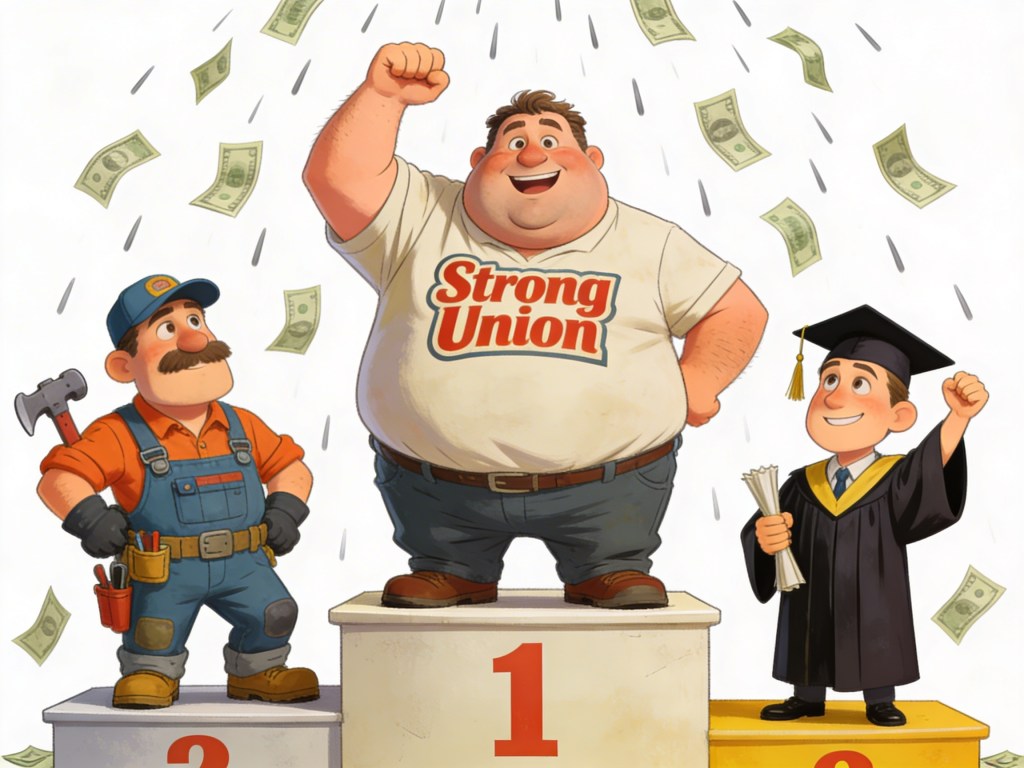
• Joe has mastered the craft of building chairs. He has made a few and they are selling well. He charges $20 for each chair. It costs him $7 to buy the wood and nails to make 1 chair. It takes him around 12 working hours to make 1 chair. $13 profit = $1 an hour for Joe with $1 leftover. He saves those dollars for a rainy day and makes 5 chairs a week. That’s $100 for a 60-hour week. $65 profit. For reference, let us say that the average rent is $20 a week. Joe’s doing pretty well for himself.

    To avoid complication, I will leave out taxes and any innovations or efficiency improvements. It’s just Joe, his skill, his tools and the raw materials.

    The chairs are selling like hot cakes, and Joe realises that he cannot keep up with demand; Joe is going to need to employ another chairmaker. Again, for simplicity I will skip an unskilled assistant or apprentice. Joe hires a craftsman that has his own tools and can build one of his chairs in 12 hours.

    Now Joe has doubled production and is making 10 chairs a week. After purchasing double the wood and nails, the profit is now $130. Of course, Joe must pay his new employee (#2) out of that money. Here we hit the first bump in the capitalist road. Joe hypothetically estimated his pay at $1 an hour. #2 is doing exactly the same work as joe. Should he also get $1 an hour?

    A Marxist may very well insist on it; anything less is exploitation. Before we explore the gamut of business expenses, let’s assume there are none. Joe started the business and Joe designed the chairs. Joe fronts the money for the raw materials and Joe got the demand increased before #2 arrived.

    If you were Joe, would you split 50/50 with #2?

    If you answered no, then I guess you can stop here.

    If your response was yes, let’s look at the most basic of overheads:

    • The work takes place on Joe’s premises and Joe is responsible for its maintenance.
    • Joe foots the bill for utilities.
    • Joe also takes the loss for mistakes resulting in waste.
    • He cops the hit for returns and refunds.

    Is an equal split still appropriate?

    A hard-core socialist might say yes. I am by no means a free-market capitalist, especially when it gets to the extreme ‘profit above all else’ larceny. There certainly needs to be checks and balances on the profit-margin moguls. On the other hand, if there were no rewards for taking the risk of starting a business venture there would be a massive decline in entrepreneurship.

    What would be the point of Joe expanding his business if every new employee shared the profits, but none of the expenses or risks? There is scope here for a new type of business model, but that is another exercise. A brief hypothetical question though: To get an equal share of profits, would you be okay with the boss deducting expenses from your pay?

    A better example might be this: If a doctor got paid the same minimum wage as everyone else, how many doctors do you reckon there would be? You can even include free education if you like. It’s a hell of a lot of gruelling study and the responsibility and pressure on you is more than a little full-on compared to loading supermarket shelves.

    I’ll say it again; I detest the outrageous profits we are seeing while people struggle to survive. However, just because one loathes an extreme, it is not necessarily a good idea to swing over to its opposite. I apologise for being a bore, but moderation is important in most cases.

    I will stop trying to convince invisible (and possibly non-existent) people. I am merely laying out my thoughts so I can observe them more clearly.

    I like the Joe analogy. I reckon I will follow his progress as his business grows and grows. I am fascinated by where it will lead. I get a feeling he is going places.

  • Mercedes: Remember when we were kids and Edmond got that whistle for his birthday, and you got a pony? You were so mad that Edmond was happier with his whistle than you were with your pony.

    The Count of Monte Cristo (2002)

    Who are these Joneses we keep hearing about?

    What is success?

    There’s the title for two books right there!

    So, how to keep this bite sized? Well, if you have a job that pays the bills and lets you have a little fun you are already doing better than a shit tonne of people. If you only ever compare yourself to poverty-stricken people, your life looks pretty fucking good! You’re welcome, see you next time.

    Okay that’s way too flippant and it also removes aspiration which can be a good thing if it is channelled properly. My focus here needs to be much more on defining success (as in a life well lived). The Joneses often just muddy the water. Competition with others, especially in something as obscure as ‘success’ is a fool’s errand.

    I’ll throw out a few generic measures of this mysterious goal: Travel, education, physical traits (beauty, physique, strength and fitness), corporate status, material possessions, money to burn, power and ability to intimidate, kindness, spirituality, love, kids. Any of those hit a nerve? If they all do, you may be beyond help.

    There’s that glibness again. It is possible that they all matter, but I am hoping that they score differently in terms of priority. They probably also differ in terms of timeline i.e. Kids by 30 or maybe 1st million or Mount Everest by 30; enlightenment by thirty maybe?

    I’m not writing a self-help guide here, but it is essential to point out 2 things:

    1. Nothing is set in stone: you must remain flexible.
    2. Goals change: what matters now may not always matter.

    I will avoid the temptation to elaborate on those other than this: adaptability and perseverance can be superpowers. Here endeth the sermon.

    My fascination lies with where these measurements of success come from. There’re the usual suspects: family, friends, society, government, media (this can of worms we will open later), school and religion. All of these will have an effect on you. Positive or negative. They may draw you in or repel you, but they will all be a part of the script for that voice you hear inside.

    If you factor in your inherent temperament and actual life circumstances and experiences, the stuff affecting your choices and behaviour has just gone from extremely complex to unfathomable. Free will debates aside, we can at least agree that a lot of the choices we make are not 100% our own. We are constantly bombarded with influences and knowing this only offers more protection; no one is immune.

    The mission I am suggesting here is trying to figure out what are YOUR ideas of success? When the curtain comes down it’s going to be you looking back and judging; most of those people you were trying to impress or outshine will be gone in one way or another. You would like to believe that all those imaginary boxes you ticked were the ones YOU cared about. The right ones? Who gets to say what that is?

    Will you feel fulfilled knowing that you have travelled to almost every country on the planet? Does your bucket list require passport stamps. Let’s say that’s your goal and you are smashing it at present. You’re at a party telling people about your recent trip to Paris and Venice. Another intrepid guest asks if you visited Bordeaux and Rome. “Shit! Maybe I should have said France and Italy”.

    If that interaction caused you noticeable discomfort, you may need to check your motivation. If you find yourself feeling like you missed something you would have enjoyed, you may need to alter your idea of what being a world traveller is; as in the places themselves, the people and experiences matter more than the sheer number. A statement like ‘I just got back from the US’ would often incur similar queries; New York, California, all those other places in the middle. The passport stamp still only counts for the USA though.

    If you find yourself feeling like you have been one upped, you may be participating in that fool’s errand I mention earlier. Was your motivation more about clout? Is this really your passion or is it what you want to be seen doing? Take away the impressed and/or jealous looks from people listening to your adventures. Forget about social media attention. Without all that, do you still feel the wanderlust?

    Only you can answer that, but if the answer is no, you could save yourself lots of time, energy and money, that can be spent on trying to find your genuine passion. Remember also that these things are on a continually changing scale of priority.

    I apologise if I seem to be knocking travel, it’s just that it seems to be growing in popularity and that intrigues me. You could run anything feasible through this test to give you a different perspective. Feasible as in doable; happiness or success are not actual things you can do. They may be the outcomes you hope for, but they should not be goals in and of themselves.

    Of course everything is open to dispute; beauty can be a target, but it is subjective (in the eye of the beholder). Power is very often dependent on the situation. Oh, we’re going to have fun with this!

    There is so much to mull over on this subject, and for me, it is one of the most important in terms of how we live and interact with each other; why we work and strive. I will definitely be revisiting this idea many times in the future.

  • My first full time permanent job began sometime in the early 1990s. It was a small lighting fixture manufacturer rune by 2 brothers. Their 2 wives ran the office and reception, and there were two other guys making the fixtures before I arrived. A grand total of 7. There are a few stories from this place (1 actually made it into the Potential Death etc. series!) This time I have a simple thought I want to follow.

    We got paid in cash. One of the ladies would hand us a little yellow envelope with folded notes and coins inside which added up to our pay that week. I don’t even recall a slip with information written on it. It was a tiny place, so any questions you had about leave or tax or whatever you just asked.

    I also remember that being a family business, they would shut for 3 weeks over the Christmas/ New year period. That only left you with 1 week holiday to use when you wanted. It was the cause of some drama when the next bloke got hired later in the year and had not accrued enough leave to last the 3 weeks. But again, I digress.

    My interest here is on…well, interest. From the banks that is.

    Most people would have still been paid in cash back then. It was then up to them if they wanted to put any of that money into a savings account. Plenty of people just didn’t have bank accounts. I remember opening an account for myself and 3 friends to save for a holiday because none of them used banks.

    I would get paid on Friday and I would walk up to the bank near my work to deposit some money into my account. Not a great amount, this was just my savings account. Eftpos was not a big thing back then and cash was king. Your keycard was mostly for finding an ATM to get cash. Seeing that I already had that cash, I would never withdraw from my ‘savings’ account unless I was really stuck.

    That is a key word here: ‘Savings’ account. I put money in there because I wanted to ‘save’ it. The only money in that account was the cash I had physically taken into the bank and given to a teller with a deposit slip. It was whatever I could spare, and the plan was to have it grow. To simply withdraw it from an ATM later would be stupid!

    I’ll not get too far into financial management and budgeting, my purpose at the moment is just to look at the drastic change our relationship with banks has had and 1 factor I believe had a big impact on that. Banks did not have automatic access to our earnings. They had to entice us to put our money into their coffers.

    Believe it or not, but back then money in an ordinary savings account increased! Seriously! The interest you earned was worth (at least a little bit) more than all the fees and charges. If you did nothing it would indeed grow, rather than be slowly chewed up until it vanished.

    Banks had to do a bit of work to entice your hard earned ‘cash’ onto their books. They also had to compete with Building Societies and Credit Unions, which had the irritating habit of trying to help people accumulate wealth, even if that was simply by not ripping them off. A financial institution that was not insatiably chasing profit and was content with just taking its’ fair cut. Inconceivable!!!

    Years passed and the banks slowly absorbed the building societies and the credit unions slowly faded away. Technological advances swept in and improved payroll efficiency and security. Much like other such innovations it resulted in many jobs lost. Payroll office staff were slashed along with armoured car and other security work. Tedious and dangerous jobs, but they paid the bills.

    Anyway, my gripe is with the choke hold on our income this new and improved service gave the banks. No more would they need to cajole our measly leftover cash for savings accounts. Oh, they would still be called savings accounts, but the whole system was upended, and the balance had greatly shifted to the banks. Depositing our cash into a bank account was no longer optional.

    Prior to this, a worker’s budget (if they bothered) might look like this:

    PAY $446.00

    RENT $180

    BILLS $50

    PETROL $20

    FOOD & FUN $100

    SAVE $90

    Only that last bit would go into the bank. Everything else was paid for in cash.

    The new set-up meant that the banks got your whole pay and charged whatever they considered was ‘fair’ to look after it for you. Those charges inevitably surpassed the interest earned on a peasant savings account, so the whole concept of compound interest was pointless. It still existed, but most people would have been unaware of it and the banks would have counted on the majority not shopping around.

    Now the budget must be worked in reverse; providing that the employee has a budgeting strategy at all. ATM withdrawals are now the norm and ‘savings accounts’ are that in name only. Anyone serious about saving would open a new account to avoid ATM temptation and find a better interest to fees ratio.

    The overwhelming majority of businesses paid their employees this way. Therefore, all those workers now had to have a bank account. All that glorious money to invest and earn with. All that extra capital meant massive profits. All those new account keeping fees meant massive profits.

    Any of that trickle down? Tell us another one!

  • Wayne, Rodney and I were walking across the road from Two Shores Caravan Park at The Entrance to the beach. Our mission was to find wood so that we could have a bonfire and invite all the other youngsters for a gathering. It was going to be so cool!

    As soon as our feet hit the sand Rodney puts up his finger and cries “ding!” Wayne and I both look at him in anticipation of his revelation. “Ding” he cries again. He points to a two story timber frame of a house under construction on the beach.

    “Construction site” he says “Equals timber” he says.

    Wayne and I agreed that this was a fantastic idea and the three of us headed over to the construction site. The sun had just gone down, so light was scarce, but we could see enough to follow a path through the rough deadwood-like growth that grew around the dunes of the beach. To walk through it is a painful experience (don’t get ahead of me).

    We casually entered the structure and prowled around looking for this elusive timber. We found none on the ground floor so we headed upstairs via a ladder in the centre of the house. We split up on the second floor and continued our search.

    When the first thump sounded I had no idea what it was, but another came in quick succession; then another. I heard Wayne scream “they’re throwing bricks!” as he whooshed past me. I had no idea where Rodney was.

    “Get the fuck out of here!” was the cry from the unknown person or persons hurling the bricks.

    It was clear that there were one or more people at ground level who were protecting the site from thieves…and we were the thieves!

    I was desperately trying to find the ladder, but in my panicked state, and in the dark, I was having no luck. I gave up my quest and headed toward the beachside where we had initially entered. The brick hurlers were positioned on the roadside of the structure and my main focus was on getting away from them.

    I got to the edge of the house on the second story and stopped. I am amazed how little effort was required to get me to jump off onto the sand. I had two choices: risk getting branded by a projectile brick or jump. I quickly chose the latter and was down on the sand still hearing bricks landing above and far off cries of abuse as I stumbled to my feet.

    I could not find the path, so I had no choice but to run through the deadwood growth. I didn’t register the pain; I put that down to the extreme amount of adrenaline running through my system (it definitely hurt later). At this stage I still had no idea where Wayne or Rodney were, I was just focused on getting to the sand and back to Two Shores for sanctuary.

    I made it to the sand and found Wayne and Rodney pacing in exasperation and exhaustion. I joined this confused pair and did my own back and forth for a few moments.  We all silently agreed to hustle back to the caravan park with our tails firmly planted between our legs.

    Upon arrival Wayne and I both turned to Rodney and almost in sync said “Ding! Great fucken idea! Ding!”

    There was no bonfire that night, but there was an awesome tale of our death defying escape from the house frame of doom.

  • I wonder if there was ever an empire that grew out of popularity rather than conquest. Imagine a ruler who was so awesome and a society so envied that people were just compelled to join; they flocked to the place, and tales of this alluring kingdom spread far and wide. It expanded to an empire purely on the influx of emigrants…. I reckon that’s more of a city & town thing. A bustling town or city makes a nice addition to an empire.

    No; empires didn’t rely on attraction. They acquired land and subjects through brute force and/or intimidation. There probably were people who emigrated with the hopes of a better life. Like all those dreamers who move to Hollywood. Almost all those people were seeking personal gains among the hustle and bustle of metropolis. A rather self-serving agenda mind you.

    Rarely did invasion result in total subjugation or annihilation, but it usually did mean you had to bend the knee to an outside institution, and things were certainly going to change. Similar to colonisation, the empires often brought new technology and other advancements to a more ‘primitive’ group. Many saw themselves as bringers of light and remover of burdens through sharing their vast knowledge.

    Like colonisation, the assholes who were just after power, glory and wealth were more than happy to let those wannabe missionaries put their noble spin on this expropriation. One does not cancel out the other and often the do-gooders caused more harm than good anyway.

    The conquered individual would never feel like a fully integrated citizen and this alienation could go on for countless generations. This marginalisation might range from feelings of not fitting in, through living on the fringes of society and being a 2nd class citizen all the way down to slavery.

    “You can keep your traditions and beliefs, so long as they aren’t too distasteful for us, but do them over there away from us. You make the place look untidy.”

    And of course, nobody ever asked these conscripted citizens about their thoughts on the matter. “We’re here to improve your lives, so shut up and do as your told. Wouldn’t you prefer to be on the bench of a winning team, rather than playing for losers?”

    Let’s be brutally honest with ourselves; it really didn’t matter how anyone felt about it, if they weren’t strong enough to resist, they were annexed. There would always be rebels and instigators, but troublemakers and even terrorists were all just part of problems an empire had to deal with.

    As a kid I thought the globe and maps of the world were constant. The innocence of youth. I have clear memories of unsuccessfully trying to find Prussia. I cannot remember the first time I came across an older version map of the world (this is all well before the internet), but it blew my mind! It was only 20 odd years ago that I began meeting people who were Assyrian and was too embarrassed to admit my confusion.

    Might be time for one of my layman examples:

    You live in a region, and you call it “Joyton”. Along come the hordes of “Madton” and they enslave you and yours. After a while the armies from “Growton” simultaneously liberate and annex you. You find out you are now part of the “Growton” empire.

    Generations later the empire is crumbling and withdrawing. However, you are now a minority in this region, and the new ‘country’ is called “Newton” (Feel free to add or remove any steps if you like). You still have close ties to your ancient tradition and customs, but your ‘ethnicity’ is now a part of that country’s history: a heritage of huge significance to some, a mere footnote to others and totally unknown to many more.

    Pride and folklore carried through bloodlines alongside rivalries, feuds and outright animosities; a very distinct separation between ‘us’ and ‘them’, and some tourist on a bus tour refers to you all as Italian. I’m sure most accept this without too much fuss when it is out of ignorance, but it could result in a fight if it is meant as an insult.

    One way I try to better understand it is to imagine how it must feel to be heaped into a regional term and having your specific nationality completely ignored. Oriental, Arab, or the piece de resistance – African!

    That all went off on a bit of a tangent. I’ll try and retrace my steps back to the turnoff and continue the line of reasoning in the next one.

    LORETTA: And it’s safe to walk in the streets at night now, Reg

    FRANCIS: Yeah, they certainly know how to keep order, let’s face it

    They’re the only ones who could in a place like this.

    REG: All right, but apart from the sanitation, the medicine, education,

    wine, public order, irrigation, roads, a fresh water system, wine

    and public health, what have the Romans ever done for us?”

    XERXES: Brought peace.

    REG: Oh. Peace? Shut up!

  • One of the great big budget disaster films; the plot is not too important. Or I should say, it doesn’t need to be too convoluted. The crucial factor for this genre is getting the audience to care for, at least some, of the main characters. Keep the suspension of disbelief going strong and get us invested in the tension and drama and you are nailing it.

    To that end, the first act is usually the ‘getting to know’ the characters, the storyline and their relationship to each other. If you can do this while getting your exposition out unnoticed you are on fire! (yeah, I know)

    Anyway, my interest here is with one specific part of the plot – the reason behind the faulty wiring that causes the fire. No prizes for figuring out it was greed, by the way.

     A quick roll call of the important characters for this sub-plot:

    James Duncan – the billionaire developer

    Doug Roberts – the brilliant architect

    Roger Simmons – the electrical subcontractor and Duncan’s son-in-law

    Michael O’Hallorhan – the Fire Chief

    For a little foreshadowing the building has been having some teething problems lately and Doug would prefer to postpone the big opening ceremony (taking place right up the top of course) a little while to be safe. Duncan is having none of that. He’s got the mayor coming for fuck’s sake!

    My first two cents here regarding this trope in general. The authority figure who refuses to err on the side of safety almost always come off as a reckless money grubber. This may or may not be true, but it is too easy for us to judge up on our high horses; especially when we’re watching a movie about the very disaster this character is betting against.

    Like it or not, a lot of people depend on this persons’ venture being a success. If they fold after every caution the enterprise may fail and then we will hate them for losing our jobs or investments: rock and a hard place stuff. Pragmatism is the only way to take that gamble and always remember the guy refusing to heed the warning does not know he is in a movie called the fucking Towering Inferno! He probably like the chances of things going smooth.

    Back to the conspiracy.

    Duncan asserts that he has full confidence in his building and even more so in Doug’s architectural brilliance. Flattery will get you everywhere. The problems seem to be electrical in origin, so naturally they want to light up the whole building for this special occasion. It’s all about spectacle after all.

    As soon as Doug realises this is happening, he orders all, but the essentials be left on to lessen the load on the dickie electrics. That’s what causes the spark, literally and the towering inferno is beginning to smoke. Cue the action.

    While Doug is inspecting a power box/station he discovers that his specifications may have been slightly downgraded; as in El-cheapo wiring. Doug is furious and confronts Roger who invokes the ‘minimum standards’ defence. Doug insists that those standards are shit to begin with and irrelevant for this building because there has never been one this tall. That is why he specified such high-quality materials.

    Chief O’Hallorhan and his team arrive on the scene and are none too keen on fighting fires in skyscrapers. When the Chief meets Doug he makes his feelings known, telling him how highfalutin architects design these soaring structures and when the shit hits the fan the work of the rescue services is made that much more arduous and risky. The people who build these steel and glass monstrosities are more interested in their own glory than the countless lives they put in peril.

    The most fascinating confrontation takes place between Duncan and his son-in-law. Duncan kicks off from the moral high ground threatening Roger with the throwing of the proverbial book for cutting corners and causing this catastrophe. A bold move considering that Roger counters with the fact that Duncan himself had told him to cut costs wherever possible; $4 million I believe the goal was.

    Roger reminds his father-in-law of his disdain for the architect’s stringent safety requirements and the cost it was adding to the venture. Roger managed to cut $2 million off that superfluous budget, which leaves another $2 million unaccounted for. Wonder how Duncan managed to save that amount of money? Touche!

    Finally, amidst all the chaos and carnage, Doug and Duncan lock horns. Duncan plucks that old minimum standards chestnut out of his ass and Doug repeats his logic from the earlier application of that crap.

    Now let me sum up the message as I see it at this point: Duncan was willing to push the limits of engineering to create a modern marvel, but these things don’t come cheap. Doug had the necessary skill to make this ‘monument to progress’ possible, but he understood the risks involved and felt the burden of responsibility of minimizing those dangers very acutely. This is not a well-matched partnership.

    Neither man can achieve their goal without the other and I suspect both turned a blind eye to the inconsistencies in their visions. Although Duncan would ultimately have the final say on construction and poor old Roger just wanted to get out from under his in-law’s thumb. Pull this off and maybe the old bastard will cut me some slack.

    As for Fire Chief O’Hallorhan, his stated objection was the sheer hubris of these men erecting these gigantic phallic symbols with total disregard for the hazards they pose to both the inhabitants and anybody needing to go in and rescue them if need be.

    So, we reach the conclusion. Many lives have been lost, and the building is proper fucked. Not exactly the spectacle they were hoping for. Survivors are counting their lucky stars and reevaluating their lives. Let’s have a final listen to what our characters are thinking after the ordeal. Then I will impose my opinion and maybe fuck things up; let’s see.

    Duncan is seated with his daughter swearing that he’ll never make the same mistakes again. Seems ‘minimum standards’ will keep him in the clear and in business. Problem: if Duncan places a bid on the next project according to Doug’s specifications he will lose and the contract will go to someone a bit more ‘profit driven’.

    Chief O’Hallorhan passes Doug and hits him with a quip about how ‘you’ hotshots build these structures without listening to the experts in risk mitigation. Doug replies with “I’m listening” and after a couple of exhausted almost grins the credits roll. I imagine we should all be feeling a little optimistic at this point.

    Cynicism alert! Have we all forgotten that Doug had insisted on materials way above the accepted standards and was ignored due to ‘bottom line’ concerns. Maybe he didn’t have the know how the Chief had in respect to rigorous safety protocols, but unless they were extremely cheap, or preferably free, they would have fallen on deaf ears just the same.

    Maybe that’s the missing piece. The Chief knew a cost-effective way for residents to be evacuated quickly and safely but was waiting to be asked about it. Shit, I hope that’s not it!

    The depressing reality is we have three blokes with skills, knowledge and resources who are about to learn that those attributes are not enough. This is where the free market comes up short; unless Duncan can afford to do it alone or he is a tyrannical despot, all the trios’ best intentions will be defeated by the lower bidder with a better story.

    Sorry for that. Follow me for more spoiling of ‘positive’ endings.

  • We’re all basically the same, right? I mean, deep down we’re all good people, right?

    Define good.

    What does ‘being good’ or ‘doing good’ mean to you?

    Heavy shit! Sort of, but I won’t drag you along the philosophical obstacle course too much. I just wanted to point out how so often a ‘simple statement’ is just that; simple. Or oversimplifying I should say.

    We’re all basically the same is ridiculous on its own but coupled with the other statement it makes sense. However, the whole statement is so broad it means practically nothing. Without a clear definition of what ‘good’ is we are lost.

    . Good as in:

    • Above average?
    • Correct?
    • Well behaved?
    • Right?
    • Righteous?
    • Nice?

    And it goes on and on. I am only concerned with demonstrating the myriad of ways a ‘simple’ statement can be interpreted based on just one word. For further bamboozlement look up any debate with Professor Jordan Peterson.

    So, you walk down the street feeling secure in your belief that everyone is fundamentally a ‘good person’. You may feel a sudden pang of dread as it dawns on you that many horrible things have been done in the name of the good, or to punish the bad.

    Get to the point!

    I led you to the edge of the semantic precipice to illustrate the silliness of simplistic explanations. Also, I was hoping the idea of leaping into the abyss would make taking the stairs seem easier.

    Most people don’t contemplate life, language and all the rest in that way (when they’re sober anyway). Therefore, we don’t need to get too deep into the quicksand for our task. Instead, how about I throw out a profound sounding quip like “Even subjectivity is subjective”.

    I lost my train of thought…

    What the hell am I trying to say?

    Right! People see the world through more diverse paradigms than we can ever imagine. Yet we’re all the same? How many of the people you interact with on a daily basis do you think would agree on ‘everything’ you believe (that they could know)? How much do we all let slide because it’s ‘no big deal’?

    The purpose of these posts is for me to try and understand the ‘system’. The networks we are all in and how we interact. From that perspective it is crucial to understand that people’s idea of what is ‘good’ has a massive effect on the way they think and behave.

    I do not wish to go too deep into nationality, race and religion at this point, so I will begin with a basic dichotomy for an example. Two people work side by side every day.

    • They like similar movies and TV shows
    • They share a dark sense of humour.
    • Their music tastes do not align so well
    • Nor do their preferred sports.
    • They both hate the boss.
    • Their ideas on love and sex differ quite a bit.

    All that kind of stuff. They get along well and agree to disagree on their differences. One of them believes in God. Not going into a specific religion or definition just yet let’s just say that one of them believes that someone or something created all this and may be:

    • Running the show
    • Watching, judging and waiting.
    • Just watching like kid with an ant farm
    • Answering prayers.
    • An ancient Greek style deity with emotions and ego
    • Etc.

    The other half of this pair is a confirmed atheist. We are born, we do stuff and we die – the end. Just because there is so much that science cannot explain doesn’t mean you just plaster the hole with God and all that stuff.

    These two could spend their working lives never really having a serious discussion on this topic and they would be fine. They will probably never come across a significant test of their faith either (except maybe in those last moments). Without even consciously considering this enormous divide between them, they would say “we’re pretty similar” and yes, they probably do think and behave much alike in many respects. The thing is why do they?

    I could go around this labyrinth for hours and never get bored, but I reckon you might. There are an infinite number of variations on just these two extremes; that’s just on one spectrum and don’t get me started on the various spectrums!

    For the theist you’d need to pin down: is this a loving God, a jealous and vengeful God, more than one God, is it omnipotent, omnipresent, male, female or both???

    For the atheist there would be questions regarding morality and meaning for a creature living on a rock hurtling through an indifferent universe. These two people may both behave in an ethical manner for completely different reasons. They could also be complete assholes and think they are in the right, or ‘good’.

    Now multiply the variables and try and fathom how it applies to an entire population. Think of these characters being higher in the pecking order of power and influence. Think of them in mobs under the spell of groupthink. It boggles the mind!

    It boggles my mind anyway. Maybe it just annoys you having to bother thinking about this. If not, please stay tuned.

  • Two things stick in my mind about that meeting. The self-applause and the story about old Reg.

    Ordinary day at work and we are all asked to scale the lofty heights and attend a farewell meeting in the first-floor offices for our boss. It was a long time ago, so most of this is pretty foggy. I do recall that this guy had not been with us very long and most of us had never even met him. His second in charge, who was taking over, was the one who regularly walked the floor and chatted with the staff. This guy preferred to sit up in his office and do whatever he did up there.

    The 2IC gave a speech and felt that this enigma of a boss was a great mentor (at least to him). Maybe this mystery man was a good boss, we had no way of knowing. It had been business as usual ever since he came aboard. That’s about all I can recall until the man of the moment stepped forward and opened his mouth.

    He proceeded to tell us about how he was bullied as a kid and that he was sure most of the bullies were now worse off than him. He was a success and they were…well doing the shit work like we were doing, I guess. He didn’t use those exact words of course, but that was gist. I can still see the bemused looks of my coworkers as we looked at each other with furrowed brows.

    “What the fuck is this?”

    “Did we go to school with this gronk?”

    His self-admiration then moved on to his beautiful and amazing wife and how they were moving to Melbourne, on to bigger and better things. Our loss I suppose.

    “I’m gunna have a great life me!” He actually fucking said that!

    At this point people started to drift away; some shaking their heads and others just giggling. “What a fucken tool!” Most of us had no idea who this honcho was, and he wants us to witness this goodbye wank-fest. People were going back to work rather than listen to it – that says a lot!

    Some stayed out of politeness or obedience. Most of us stayed just to see what was coming next. It was fascinatingly bizarre!

    Unfortunately, time has erased any other inspirational wisdom given to us by that paragon of modesty, but the Reg yarn has never left me. I’ll tell it in our departing leader’s words.

    “I remember when I was running the H&^%$sh depot. There was this old bloke called Reg who loaded the Gold Coast trailer. One afternoon we got an email enquiring about a parcel and so I was in the GC trailer having a look for it. Reg arrived and saw me in his trailer and he was furious. He told me to ‘get the fuck out of his trailer!’ I didn’t mind though because he always made sure that trailer was loaded properly and on time. I knew I could rely on Reg.”

    When we were finally released from that most peculiar performance the talk was a cross between the insane trumpet blowing and Gold Coast Reg. Our ex-boss, Mr success was impressed with Reg’s dedication. For the rest of us the impression was unanimous.

    “Poor old Reg has lost the fucken plot!”

    “Is he telling us to model our behaviour on a nutter?”

    We’ve all worked with people like that and if you’ve been around long enough you would have been there to see how little the impact of them leaving is. Barely a blip on the radar of the day to day. Of course, those who interacted with him will remember the character he was, but the business will go on as if nothing happened. They took the job so seriously and were replaced so seamlessly like a worn-out cog.

    That said, nobody missed the boasting boss either. At least he went on to greener pastures I suppose. Such a strange event.

  • It was one of Wayne’s shitbox cars again. We were both drunk after a session with the boys at The Vic on the Park hotel. Driving home Wayne decided he wanted to have a little fun in the rain around Mackey Park. I still have no idea what exactly he was trying to do. He would drive up the steep hill that was Premier Street, do a sharp U-turn, then drive along Carrington Road; turn into Richardson crescent and spin the wheel side to side. Like I said I have no idea what he was trying to achieve and I have no idea why I didn’t tell him to stop it. Luckily it was late and there were no other cars around

    He had already performed this strange manoeuvre twice and was driving up Richardson Crescent for the third time. He was spinning the wheel form side to side and we were zig-zagging up the road. This time the rain did its job and the wheels seemed to lose all traction. We were spinning out of control and it seemed to me that we spun at least two 360s.

    Suddenly we straightened up and were headed straight for Mackey Park. The terrifying part was that we were way up Premier Crescent and were heading for a very steep hill down into Mackey Park; the flimsy wire fence could do precious little to prevent us from plummeting down the hill and slamming into the turf below.

    By some miracle the car stopped just before we hit the fence. I say miracle but I am pretty sure it was the gutter that prevented us from a serious crash. Sing hallelujah for gutters! I reckon the wheels must have been buckled from the impact and I didn’t give a shit. I was just overjoyed that the potential plummet had been averted.

    I remember having to pry my hands from the dash board; I was holding it so tight.

    I think I managed to utter “you idiot” and that was all.

    We drove silently home and I do not know what damage was done to the car. I was just glad to make it home in one piece. “Fuck the car” was my sentiment.

  • You’ve connived your way to the head of the table in the village. You’ve annexed a bunch of smaller villages and tribes. Maybe even seized some big ones. You are now ruling an empire! Congratulations. You’re on easy street now…

    I’m afraid I’ve got bad news sir.

    Ever notice how throughout history occasionally, some kid ends up on the throne? Maybe his mother is in charge until he comes of age or some other arrangement. There must be a lot more going on behind the throne than we think. Power is a baffling entity, and I will not presume to understand it. What I do know is that it is fickle and can be fleeting. In many ways it seems to be an illusion.

    While this means it is not tangible, make no mistake, it is real. Although, it’s not the crown and throne that bestows authority; it is the perceived power behind those symbols that commands compliance. The story of regal heritage and the collective consensus regarding its legitimacy perpetuate the myth.

    Eventually the maintenance of this majestic supremacy becomes a small industry. An entire entourage dedicated to keeping the show on the road. All sorts of advisors and assistants; a treasurer/y, generals etc. They all have a lot of motivation to keep the status quo. A change in leadership could mean a reshuffle and that is unacceptable.

    So, let’s say that an emperor dies and his only heir is a kid. If the kid is passed over the whole regal legend is open to interpretation. This may well result in that most unwelcome shake-up if any cunning conspirators play their cards right. The old guard must work fast to prevent any subversion.

    That one kid could be the only thing standing between the former imperial court and oblivion. The very lucky ones might keep their position or at least get a lower spot in the court. Some will be sent packing to hang with the plebs. Some will disappear – be that exile or execution, depending on what kind of enemies you made during your career.

    The concept that the king or queen rules absolutely is rarely a reality. Even a tyrannical despot needs people to rely on; maybe not trust, but you can’t do everything on your own. These empires are complex systems with way too many moving parts; and who is in charge of security? Who is literally watching your back?

    There is no avoiding everyone’s dependence on others. Even the one at the top has to let their guard down. At the bare minimum they must eat, drink and sleep. It must be torture to a paranoid mind. For that matter it must be very difficult not to have a few major trust issues and the best double-crossers always make you believe they are friends.

    It all seems so exciting in fiction, all the intrigue and power plays. What an absolute nightmare it would be to live through. All that power and wealth, but no true security. Living in a hornet’s nest constantly trying to keep ahead of the devious machinations of those around you. All this before you even begin dealing with all the outside threats. I know the peasants lived knee high in shit, but the grass aint necessarily greener in the tower.

    The ruler may well have the power of life and death over their subjects, but one false move can bring the whole façade undone. Many a backstabber will try and fail. Many an iron hand king who ruled by fear has wound up being fed to the angry mob. As has a benevolent one too, sadly, I’m sure.

    A lot of what the emperor does, seemingly of their own free will, is a forced move. Maybe it is to appease the populous, or someone who may hold a lot of sway with them. It may be a pre-emptive attack to thwart a suspected coup. Or it could be a purely defensive move to gain a little breathing space.

    The fucked-up thing for me is the never knowing. You evaluate the situation, you make a move and you can never be sure if you made the right decision. You create enemies and corpses, and you will be forever ignorant if they were truly friend or foe.

    These are just my assumptions or course, but a ruler who gets on the wrong side of his court and/or subjects better be fucken scary and have eyes in the back of their head. If not, he may well lose that head.

    A lunatic or a fool may be tolerated by the powers that be for the same reason the child emperor is: they are easy to control. Start getting too big for your boots though and get ready for a rude surprise.

    So yeah, empires hey? At first glance it’s easy to tell who’s in charge, but you never really know.