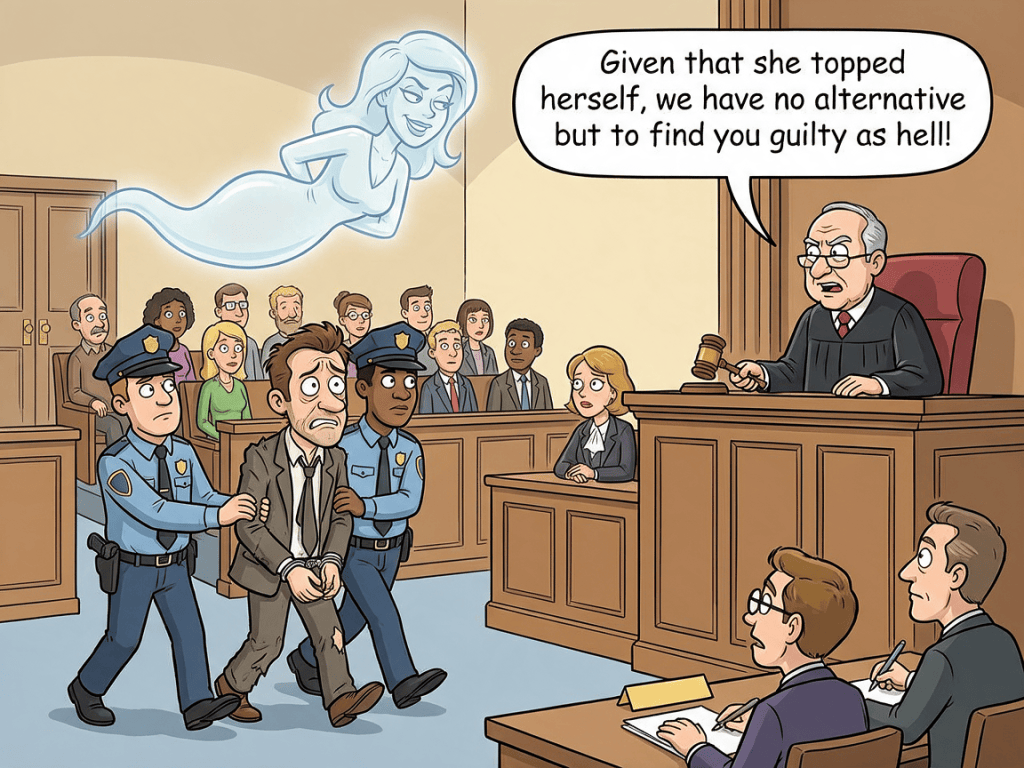
I didn’t put this one under the Movie Musings banner because I have been unable to find the title of the movie and I will be going off a single viewing from very long ago. While the specifics are missing, the overall theme and conclusion still intrigue me, so I will be focusing on those aspects. Questions like:
“How do you know you know?”
“How can you be sure that other person knows?”
“How reliable are our memories?” That’s a good one in this context.
I was only a kid when we watched it on video, so I didn’t question much. It seemed rather cut and dry to me back then. The deeper philosophical significance didn’t occur to me till much later. The ambiguities within that tale only served to make it more profound. Maybe the lack of closure was the lesson.
My memory is foggy and the details are sketchy, so please bear with me. I believe it takes place in the USA around the 1980s. An elderly woman (I’m assuming she’s Jewish) who survived a Nazi concentration camp, is certain she has found the sadistic officer who oversaw or perpetuated atrocities and abhorrent cruelty. She is determined to expose him for his evil deeds. She follows and harasses him as he tries to go on about his upstanding life in America.
The man’s adult daughter adores him and is horrified at this woman’s misdirected accusations. The man vehemently denies the vilification and seems genuinely baffled. He was indeed German and in Germany during WWII. I cannot recall if he admits to working in the camps or not. Either way, he swears he is not this monster the woman says he is.
At the climax of the film, the woman approaches her alleged abuser with a gun. Rather than shooting him, she looks him in the eyes and turns the gun on herself in front of a crowd of onlookers. The final scene has the man remaining tight lipped, while his daughter looks at him with agonised doubt.
“She must have been so sure” says the heartbroken daughter before turning her back and walking away.
As a kid I swallowed that logic hook, line and sinker and I am sure the film meant for the rest of the audience to do the same. Although I believe it was left open ended. If anyone knows the title of the film, I would love to know.
40 odd years later and a lifetime of discovering things I was certain about were either wrong, or quite different from my conception; countless arguments over flawed recollections; mine and others. I am no longer so sure about much anymore, and I am amazed by anyone who is. As I grew, my curiosity grew along with me and the implications of that story, in regard to knowledge and proof, expanded along with my bewilderment.
We will never know the trauma that old lady suffered, and we can only imagine her yearning for justice. The unclear ending makes me believe that there must have been a lot of circumstantial evidence and unanswered questions regarding the alleged war criminal which led to the woman’s final act.
This is the nightmare of being outside of a dispute and only having people’s differing versions to go on. “She must have been so sure” is one interpretation. I’m not trying to be flippant, but there are other explanations, not least of which would be “shit, I hope she wasn’t mistaken!”
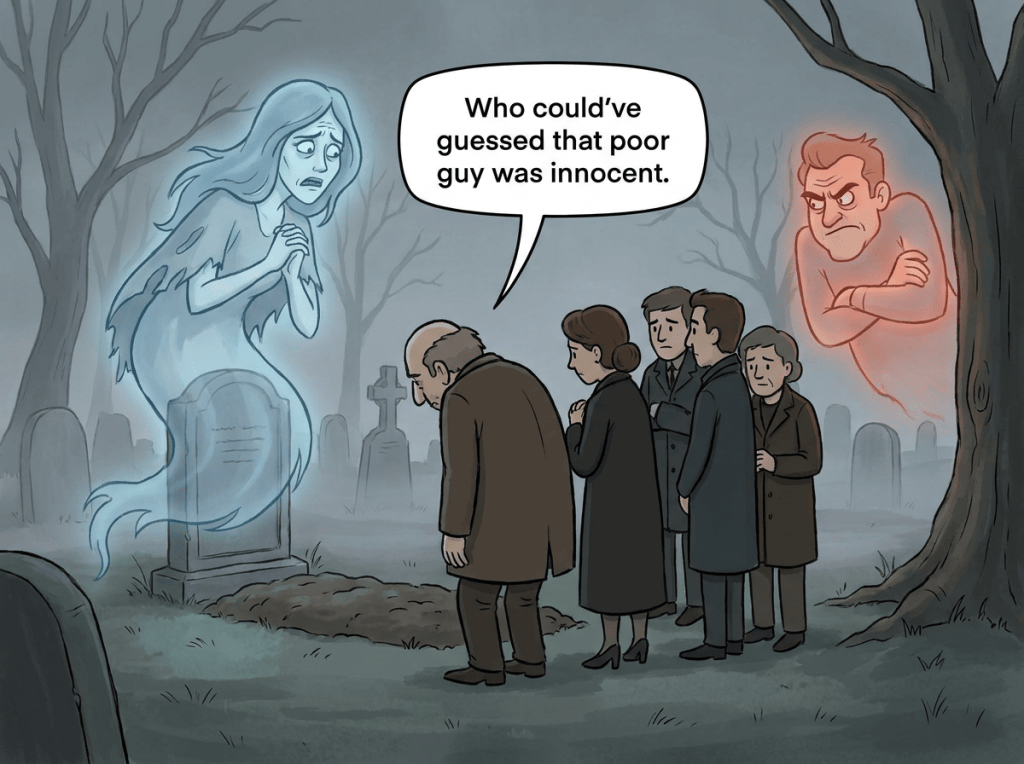
The accused may not have been on trial officially, but that suicidal condemnation certainly placed his reputation and relationship with his daughter in major peril. Maybe it was one of those mystery story cliches where he couldn’t reveal his exact whereabouts during the period in question because he was doing something else he wanted to keep a secret; cheating on his wife perhaps, or maybe something even worse than what he was being accused of. Christ, that would have to be fucking awful!
Either way, the woman was fed up with being disbelieved and her tormented psyche demanded retribution. So, she carried out a definitive and terminal act to finally close the book on her horrific ordeal. A “once I do this it will finally be over” type ritual.
While it leaves little doubt regarding her anguish and the conviction behind her incriminations, there will always be that lingering misgiving. The fact that she took her own life will, for many, be evidence enough for the credence of her story, and anyone wishing to argue will be doing so with a ghost. As far as she is concerned, the case is closed.
Unfortunately, certainty does not automatically equate with being in possession of the “truth”. Ending your own life will absolutely add weight to your grievance and may even force some type of further investigation. It cannot be seen as irrefutable evidence though.
It is a very effective way of ending a dispute and literally having the last say. If nothing else, it cements the psychological and/or emotional pain as your reality. Although it will never prove what actually happened on its own. The major attraction to this form of exercise in terms of justice may well be the “they must have been so sure” conclusion many people will make. Anyone who questions the deceased woman’s assertions will be seen as heartless or maybe even a Nazi sympathiser!
If you kill someone, you are left to face the consequences. There will be an investigation, and many questions will be asked. Imagine finding out you killed the wrong person? Or maybe discovering sufficient evidence to make you much less sure regarding your chosen villain. Quite a horrendous cross to bear on top of what was already crushing you.
Maybe self-erasure is preferred because it ends your suffering while ensuring the torment of your nemesis. Is it one of those “death is too good for them” things? The questions are endless! Maybe that’s why many people choose to go with the simplest or most popular conclusion.
In my memory as a kid, I was sure he was the evildoer. And now? Now I just reckon I would be a massive pain in the ass for my fellow jurors.
This was a strange one, I know. Talking about a movie I only have sketchy memories of. Having hired it from a video shop in the 1980s there’s also a chance it was a TV movie in the USA, which would make it that little bit more obscure.
Anyway, it left an impression on me and gave me an introduction into things I would later become very interested in, such as psychology and epistemology. Perhaps it even planted the seeds.


Leave a Reply